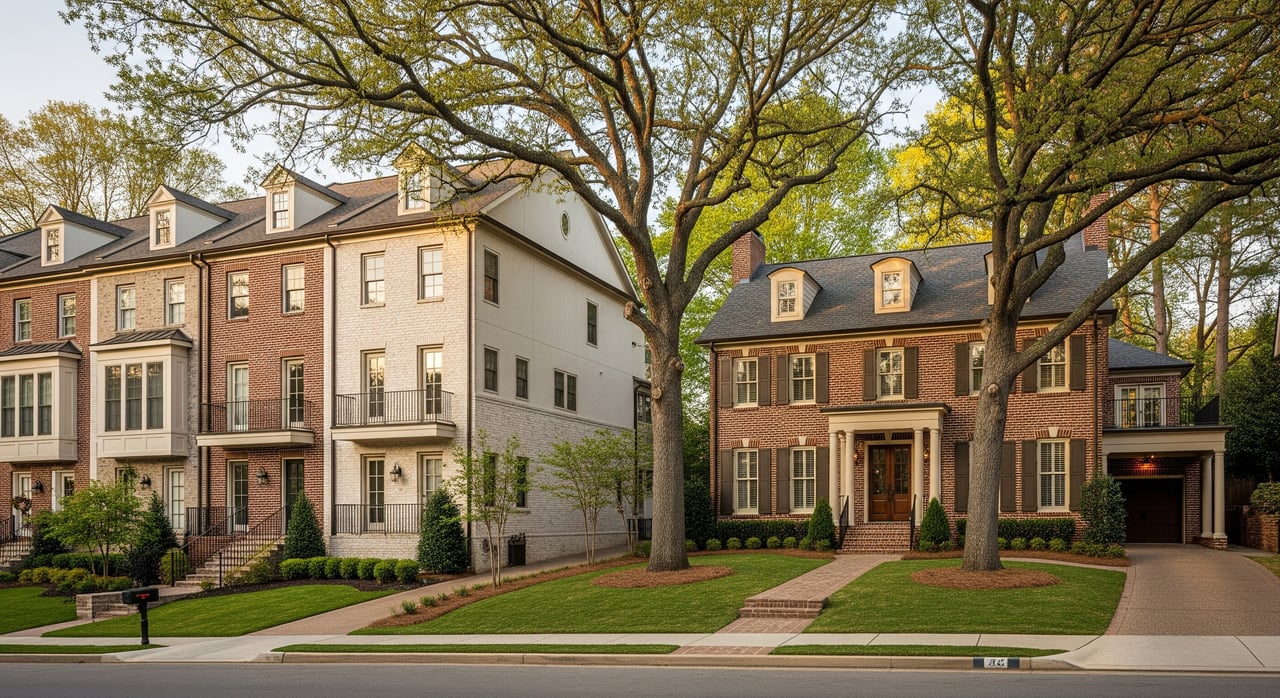
Trying to decide between a townhome or a single-family house in Sandy Springs? You are not alone. Many buyers weigh lower maintenance and location convenience against space, privacy, and long-term value. In this guide, you will learn how total cost of ownership works, what HOAs really cover, and how resale dynamics play out locally so you can choose with confidence. Let’s dive in.
The real cost picture
Purchase price and financing
Townhomes often come with a lower entry price than single-family homes, but this varies by neighborhood and age of construction. Your loan size drives your monthly principal and interest, so even modest price differences matter. Use an apples-to-apples comparison that looks at cash flow today and total cost over your likely holding period.
Fulton County property taxes
Property taxes are calculated using assessed value and local millage rates. You can look up parcel records on the Fulton County Board of Assessors, then apply current millage details from Fulton County’s tax resources. Georgia homestead exemptions can reduce taxable value if the home will be your primary residence, so confirm eligibility.
Insurance differences
Townhome insurance needs depend on your association’s master policy. If the master policy covers exterior elements or the roof, your individual policy may be a “walls-in” policy at a lower premium. Single-family homes require full dwelling coverage, which is typically higher due to full replacement cost and lot exposure. Always align coverage with the master policy’s scope.
HOA dues and assessments
HOA dues can simplify life if they include exterior maintenance, landscaping, trash, roofs, or amenities. Ask for the budget, reserves, and recent meeting minutes to see what is funded and what is deferred. Guidance from the Community Associations Institute explains how reserves should be structured and why shortfalls can lead to special assessments.
Utilities and services
In many townhome communities, exterior services are included in HOA dues. In a single-family home, you will pay for lawn care, tree work, pressure washing, and sometimes higher water use for irrigation. Compare seller-provided utility bills and any service contracts to estimate monthly out-of-pocket costs.
Maintenance and repairs
Townhomes shift some exterior responsibilities to the HOA, depending on the governing documents. Single-family homes place all interior and exterior upkeep on you. A helpful rule of thumb is to set aside 0.5% to 2% of the home’s value per year for maintenance, adjusting for age and condition. Big items include roofs, HVAC, water heaters, and exterior paint.
Closing costs to expect
Closing costs are similar across property types, with a few differences. Townhomes can carry HOA transfer fees and document fees. Your insurance and inspection mix may also vary. Build these into your cash-to-close plan.
Build a monthly total
A clear comparison uses one formula:
Monthly total cost = mortgage P&I + property tax/12 + owner insurance/12 + HOA (if any) + utilities + maintenance reserve/12 + other recurring fees.
Run this for each target property so you can compare true monthly outlay rather than just the mortgage.
Maintenance and HOA governance
Who handles what
Do not assume the HOA covers roofs or siding. The definition of the “unit” versus “common elements” in the CCRs determines responsibility. Some associations only handle common landscaping and amenities, while owners handle building envelopes. Confirm responsibilities in writing before you buy.
Financial health checklist
Ask for the current budget and prior-year actuals, reserve study and balance, insurance certificate, minutes from recent board meetings, rules and regulations, and any litigation disclosures. Red flags include very low reserves, frequent special assessments, major deferred maintenance, or pending lawsuits. CAI’s best practices, found on the Community Associations Institute website, can help you evaluate the financial picture.
Master insurance and deductibles
If the master policy covers the building shell, your personal policy may be smaller, but pay attention to master policy deductibles. High deductibles can result in owner assessments after major storms or water events.
Rules and modifications
Townhome communities often require architectural review for exterior changes, paint colors, fencing, and additions. These rules protect uniformity and can help resale, but they reduce flexibility. Ask for the architectural review process and timelines so you can plan projects accordingly.
Resale dynamics in Sandy Springs
What drives value
For both townhomes and houses, location near employment centers, major corridors, medical clusters, and MARTA access tends to support demand. Sandy Springs planning and zoning updates, available through the City of Sandy Springs, help you understand development patterns that can influence future value. School attendance zones can shape buyer demand; verify boundaries if they are important to you.
Buyer pools and liquidity
Townhomes attract first-time buyers, downsizers, and those prioritizing low maintenance and location efficiency. Single-family homes draw buyers seeking space, private yards, and expansion potential. Liquidity can be strong for well-located townhomes near walkable corridors, while houses on larger lots often retain interest across market cycles.
Appreciation patterns
Across long horizons, land often drives appreciation for single-family homes. That said, periods of strong demand for low-maintenance living can lift townhome pricing, particularly in walkable areas. Use recent local comps and days on market to judge trends rather than national assumptions. General market research from the National Association of REALTORS can offer context, but rely on local data for pricing decisions.
Renovations that resonate
Townhome interiors benefit from updated kitchens, baths, and flooring. Exterior changes may be limited by CCRs. For single-family homes, improving curb appeal, expanding usable outdoor space, and adding flexible living areas can drive buyer interest.
Townhome specific risks
Rental caps, litigation, poor management, or reserve shortfalls can affect values. Review HOA documents closely and consider how restrictions might influence the buyer pool when you sell.
Decision checklist
- Set your monthly budget, including taxes, insurance, HOA, utilities, and a maintenance reserve.
- Decide how much exterior upkeep you want to handle.
- Clarify your needs for a yard, parking, and storage.
- Consider your flexibility needs for renovations or rental options.
- Define your time horizon, less than 5 years or more than 10 years, since that shapes appreciation strategy and transaction costs.
- Gauge your tolerance for HOA rules and potential assessments.
- Map commute patterns and verify any school boundary preferences.
Example scenarios to compare
Scenario A: first-time buyer, townhome
Assumptions: purchase price P_t, down payment D_t, mortgage rate r, HOA H per month, assessed value A_t with tax rate T, owner insurance I_t per year, maintenance reserve M_t per year. Monthly cost = mortgage(P_t, D_t, r) + (A_t × T)/12 + I_t/12 + H + M_t/12 + utilities.
Scenario B: downsizer, single-family
Assumptions: purchase price P_s, down payment D_s, mortgage rate r, assessed value A_s with tax rate T, owner insurance I_s per year, maintenance reserve M_s per year, yard care Y per month. Monthly cost = mortgage(P_s, D_s, r) + (A_s × T)/12 + I_s/12 + M_s/12 + Y + utilities.
Break-even horizon
If the house’s monthly mortgage is higher, compare that difference to the townhome’s HOA plus any maintenance savings. Over time, factor in expected resale behavior and transaction costs. When the cumulative differences meet, you have a rough break-even point. Use current comps, tax records from the Fulton County Board of Assessors, and city context from the City of Sandy Springs to refine your inputs.
Due diligence steps before you offer
For townhomes
- HOA budget, reserve study, financials, and insurance certificate.
- CCRs and rules, including rental policy and architectural guidelines.
- Board meeting minutes, special assessment history, and litigation disclosures.
- Clarify who pays for roof, exterior walls, decks, and driveways. CAI’s resources on HOA governance and reserves can guide your review.
For single-family homes
- Seller disclosure and maintenance history for roof, HVAC, water heater, and major systems.
- Recent utility bills and service contracts for lawn or pest control.
- Survey or lot line documentation, and any well or septic records if applicable.
Local data sources you can trust
To confirm numbers, use the Fulton County Board of Assessors for parcel values and the Fulton County tax pages for millage information. For planning and development context, the City of Sandy Springs provides zoning and neighborhood resources. For demographic and housing-stock context, explore the U.S. Census data portal. National research from the National Association of REALTORS offers useful trends, but validate pricing with local comps.
Ready to compare homes in Sandy Springs?
If you want a side-by-side, total-cost view of specific townhomes and houses, you do not have to figure it out alone. With local expertise and a clear, process-driven approach, Kelli Adams will help you weigh costs, maintenance, and resale factors so you can buy with confidence.
FAQs
What does a typical HOA fee cover in Sandy Springs?
- It varies by community, but may include exterior insurance, roof, landscaping, amenities, trash, and reserve funding; confirm with the HOA budget and CCRs, and consult CAI’s guidance on reserves.
How are Fulton County property taxes calculated for buyers?
- Taxes are assessed value multiplied by applicable millage rates, minus any exemptions; verify parcel data on the Fulton County Board of Assessors site and millage on the Fulton County tax pages.
Is insurance usually cheaper for townhomes than houses?
- Often yes, if the HOA’s master policy covers exterior elements, but you must match your policy to the master coverage and deductibles; request the master insurance certificate before binding your policy.
Which tends to hold value better in Sandy Springs, a townhome or a house?
- It depends on location, land, and community dynamics; single-family homes can benefit from land value, while well-located townhomes can be very liquid; use recent local comps and trends rather than national averages.
Are rentals allowed in most townhome communities?
- Many have rental caps or restrictions; check the rental policy in the CCRs and confirm current status with the HOA and recent meeting minutes.
How can I estimate my monthly housing cost before shopping?
- Use the monthly total formula that includes mortgage, taxes, insurance, HOA, utilities, and a maintenance reserve; validate assessed values on Fulton County’s assessor site and factor in any HOA dues and services from the disclosure packet.